
3: Provide Benefits and Resources Support
These steps follow the journey map below. To download the journey map, click here.
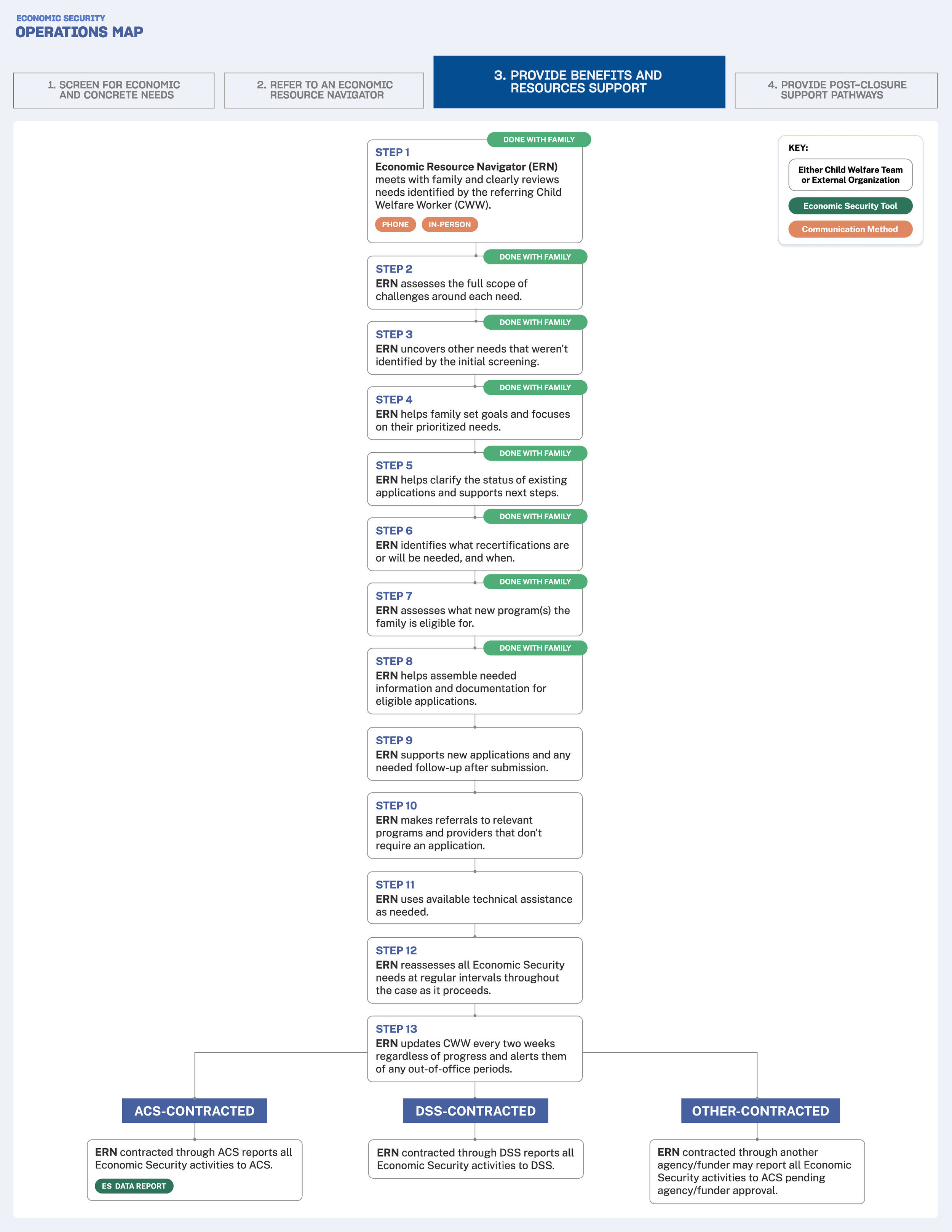
Steps
ERNs must:
1. Meet with the family or young person and clearly review the needs identified by the referring Child Welfare Worker.
Use the information shared by the Child Welfare Worker explicitly. Say things like "I know you already shared that you…" or "You expressed previously that…" and then ask follow-up questions, rather than ignoring information they've already provided.
2. Assess the full scope of challenges around each need.
Child Welfare Workers keep their initial screening brief to flag that help is needed. It's then up to the Navigator to dig deeper and ask the follow-up questions needed to understand what's really going on.
Severity: What's at stake, and what is the frequency or urgency?
Underlying Factors: If the young person or family has applied for or received support for this need before, why is there still a challenge?
Previous Obstacles: If their applications have been denied, why?
3. Uncover other needs that weren’t identified by the initial screening.
Feel out the right opportunity to screen and probe for other needs that haven't been identified. This might happen during the first conversation, but it might be easier during the second or third.
4. Help families and young people set goals and focus on their prioritized needs.
Let the family or young person set a couple primary goals, such as an educational milestone, resolving a legal situation, or securing new housing. Spend your initial time focused on those. Supporting their goals builds trust and openness to you helping them with other needs.
5. Help clarify the status of existing applications, and support next steps.
6. Identify what recertifications are or will be needed, and when.
7. Assess what new program(s) the young person or family is eligible for.
8. Help assemble the needed information and documentation for eligible applications.
9. Support new applications and any needed follow-up after submission.
10. Make referrals to relevant programs and providers that don't require an application.
11. Use available technical assistance.
As you support the family or young person with assessing eligibility, application status, recertification, document gathering, and referrals to other programs, make use of the training and technical assistance offered (see Training and Technical Assistance).
12. Reassess any other economic security needs not identified by the Child Welfare Worker at regular intervals as the case proceeds.
13. Update the Child Welfare Worker every two weeks.
Send an update even if you haven't yet met with the family or young person, or if there's been no progress. The report should cover what is being done to meet the family's needs, what supports are being pursued or applied for, and the status of those applications, whether preparing to submit, submitted and pending, or accepted/rejected. This is necessary because the Child Welfare Worker relies on your update to know the case is still active and being worked. Silence can be misread as the family or young person having disengaged or the referral having stalled, which can trigger duplicate outreach or a loss of trust in the referral process. A quick "no progress yet, still attempting contact" update keeps the family accounted for and the case accurately documented. Generate the report through your internal systems and email it as an encrypted attachment to the referring Child Welfare Worker.
If the referring Child Welfare Worker is in-house, they might have access to the internal systems where you have documented your work. Report or check-in biweekly through your preferred mode to offer any needed context.
14. Alert the Child Welfare Worker of any extended out-of-office periods.
15. Report all Economic Security activities to ACS or DSS.
NYCBenefits ERNs should report via regular NYCBenefits Reporting. All other ERNs should report activities to ACS through the Economic Security Activity Report.