
Embedding ECRS into CoQI
CoQI Vision for Economic Security
ACS is committed to integrating economic security into core child welfare practice beyond the ACS Economic Security program to ensure the quality of economic security services provided and outcomes achieved by ACS-contracted providers. To achieve this long-term vision, the ACS Agency Program Assistance (APA) unit within the Division of Policy, Planning, and Measurement (DPPM) will expand the existing Collaborative Quality Improvement (CoQI) model to incorporate valid and reliable economic security data indicators developed by the ACS Economic Security program. Providers will collect and report this data on an ongoing basis, allowing APA to make informed assessments about economic security-focused improvement priorities and collaboratively develop improvement plans over an annual cycle.
CoQI uses a five-step protocol that follows an annual "Plan-Do-Study-Act" (PDSA) continuous quality improvement process, with periodic status checks between key steps to maintain open communication between APA and providers. CoQI also aligns with the Provider Agency Management System (PAMS) annual review cycle to streamline and optimize the use of data to inform decisions.*
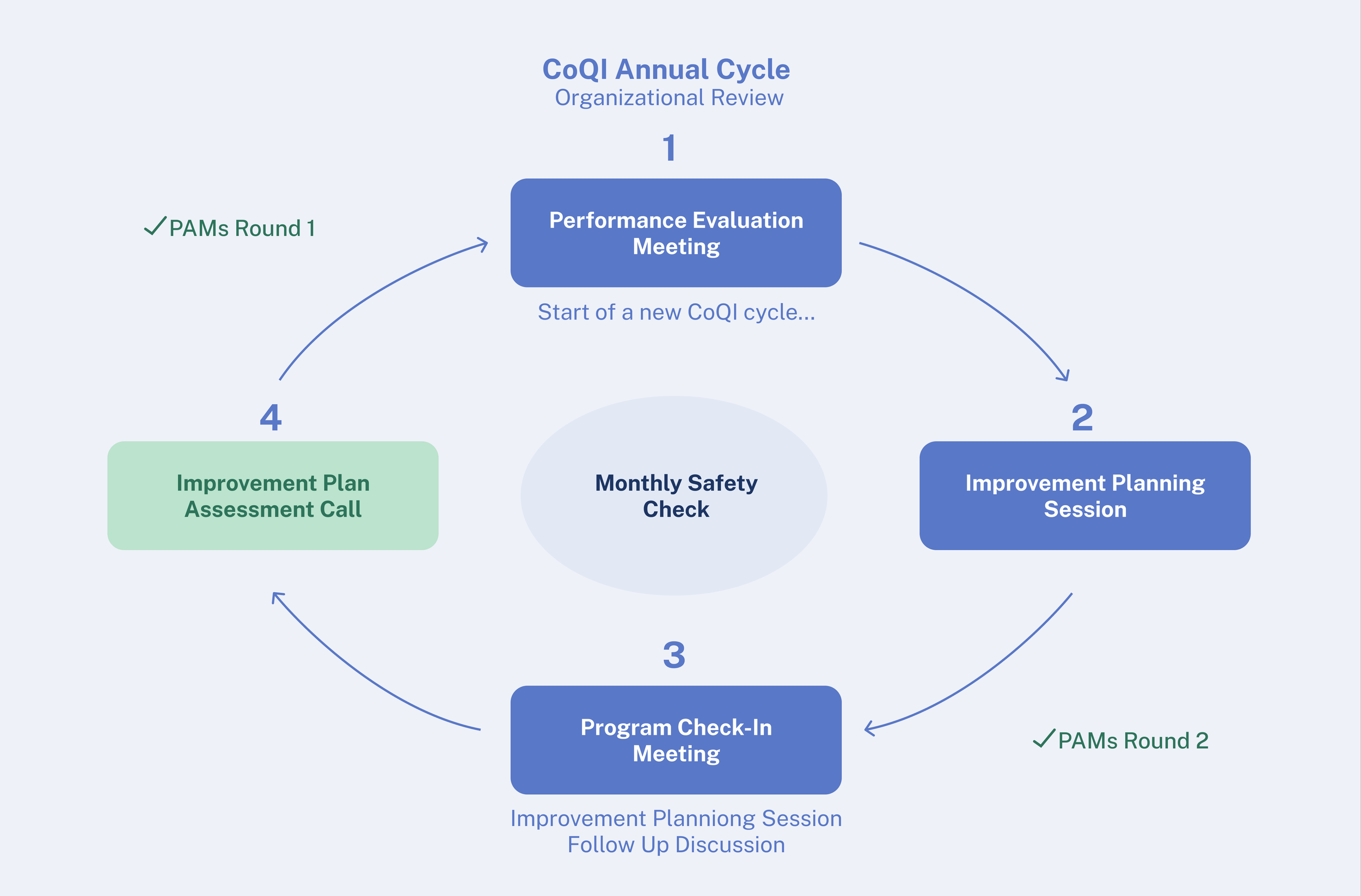
In this way, economic security will become a core component of APA's functions in:
Monitoring program performance using quantifiable performance data (e.g., case reviews, interviews, PAMS modules)
Identifying program-specific strengths and weaknesses through data collected from comprehensive evaluations of economic security case practice and services delivered
Compiling summary reports comparing performance productivity to stated goals and objectives
Providing guidance and feedback in quality improvement plans with clear expectations and timeframes for improvement
Identifying provider needs for assistance and providing the appropriate assistance to meet those needs
CoQI Measurement Framework for Economic Security
While the exact economic security data indicators and data sources for consideration in CoQI are still being refined, they will be drawn from the data reporting requirements developed in this initiative (see Data Reporting) —specifically, from:
Child Welfare Workers’ case/progress notes entered in CNNX documenting economic security activities conducted by Child Welfare Workers (e.g., family engagement, screening, referral) and economic security activities conducted by ERNs (e.g., assessment, application, securing benefits) that provide a holistic picture of case management centered on economic security
Regular reporting submitted to ACS by both Child Welfare Workers and ERNs
In the long term, economic security-focused quality standards and indicators for prevention services, foster care, juvenile justice, and Family Services Unit (FSU) will be developed to provide clear guidance for providers to engage in quality economic security practice. These economic security-focused quality standards and indicators will, in turn, also inform and refine PAMS (e.g., case record review guidelines and questions) accordingly. As a result, economic security will be integrated into CoQI’s annual PDSA cycle and aligned with the PAMS review calendar.
CoQI Expectations for Providers
At this stage, providers will only need to commit to the data reporting requirements outlined in this playbook. Chapin Hall will coordinate with APA to identify specific parts of the existing CoQI model that will be modified or expanded. More concrete guidance and training will be provided to providers when the program is being prepared for scaled implementation.
*New York City Administration for Children’s Services. (2018). Agency Program Assistance collaborative quality improvement desk guide. Division of Policy, Planning, and Measurement, New York City Administration for Children’s Services.